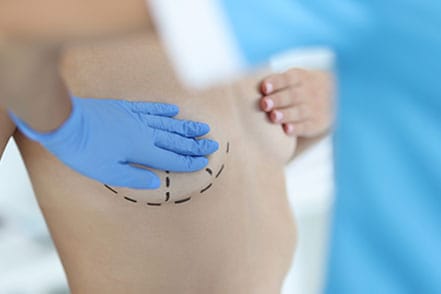
Scars are a normal and unavoidable part of breast reconstruction. Their appearance depends on the reconstruction technique, incision placement, genetics, skin tone, additional treatments, and how your body heals. Flap reconstruction may also produce scars at the tissue donor site, such as the abdomen or thigh.
Fresh scars commonly appear raised, firm, pink, red, or darker than the surrounding skin. Most gradually flatten and fade, but this process can take 12 months or longer. Thoughtful aftercare may support better healing, although no treatment can erase a scar completely. At New York Group for Plastic Surgery, board-certified Dr. Jordan M.S. Jacobs offers detailed aftercare guidelines and scar care recommendations to help ensure a smooth recovery.
What helps after breast reconstruction
Following your surgical instructions
During the initial recovery period after breast reconstruction, protecting the incision is more important than applying scar products. Follow your surgeon’s directions for cleaning the area, changing dressings, wearing compression garments, and managing drains.
Avoid soaking the incision or applying unapproved products while the skin remains open. Keep all follow-up appointments so your surgical team can identify delayed healing, fluid buildup, or infection before it becomes more serious. Contact your care team if you experience increasing redness, warmth, drainage, worsening pain, fever, or an incision that begins to separate.
Silicone gel or sheets
Medical-grade silicone is one of the better-supported topical options for managing surgical scars. Silicone gel and reusable sheets help keep the scar hydrated and may reduce redness, thickness, itching, and firmness.
Silicone should generally be introduced only after the incision has fully closed and your surgeon confirms that it is safe. Consistency matters: products often need to be used daily for several weeks or months. Your surgical team can recommend the appropriate format and application schedule for your skin and incision location.
Scar massage after clearance
Gentle massage may help soften a firm scar and improve mobility. However, beginning too soon could place tension on a healing incision.
Wait until your surgeon confirms that the wound has closed securely. You can then receive guidance on how much pressure to use, how long to massage, and whether massage is appropriate around reconstructed tissue. Scar massage is different from breast or implant massage, so do not begin either without specific instructions.
Sun protection
Ultraviolet exposure can cause a healing scar to become darker and more noticeable. Once the incision is fully healed, protect it with clothing or broad-spectrum sunscreen with an SPF of at least 30 whenever it may be exposed.
Sun protection remains important even after redness begins fading. Scar tissue can stay sensitive to ultraviolet radiation for many months.

What doesn’t help after breast reconstruction
Picking or scrubbing the incision
Removing scabs, surgical glue, or adhesive strips before they loosen naturally can reopen the skin and increase the risk of infection or more visible scarring. Scrubbing the incision or using harsh exfoliants can also disrupt healing.
Allow dressings and scabs to separate as directed. If adhesive remains uncomfortable or appears to irritate your skin, contact your surgical team rather than removing it yourself.
Harsh antiseptics and unapproved remedies
Hydrogen peroxide, rubbing alcohol, and other strong antiseptics can damage healthy healing cells when used repeatedly. Vitamin E, essential oils, and heavily fragranced creams are also not guaranteed to improve scars and may cause irritation or contact dermatitis.
A product labeled “natural” is not automatically appropriate for a surgical incision. Ask your surgeon before applying oils, creams, supplements, or home remedies.
Rushing your recovery
Heavy lifting and strenuous upper-body activity can create tension across incisions. Nicotine can restrict blood flow and interfere with wound healing. Ignoring activity limitations or returning to smoking too soon may increase the risk of healing complications.
Even excellent scar care cannot produce an immediate result. Scars mature slowly, and their appearance may change significantly throughout the first year.
When professional scar treatment may help
Some people develop raised, widened, thickened, itchy, or dark scars despite following every instruction. Depending on the concern and healing stage, treatment may include steroid injections, laser therapy, microneedling, medical tattooing, or surgical scar revision.
At New York Group for Plastic Surgery, Dr. Jordan M.S. Jacobs and our team guide patients through every stage of breast reconstruction and recovery. We provide instructions based on your procedure, incision pattern, and healing progress.
Contact our practice to learn more about breast reconstruction and postoperative care in New York City.